This guide shows you how to run your approved revenue reports in a royalty run to generate statements for your payees.
| In this article |
How royalty runs work
A royalty run creates statements that distribute the revenue from your approved revenue reports among all of your payees, according to their contracts.
| Note Which contract applies: for each sale, the run uses the most specific contract: track, then release, then label or artist, then account. Every client has an account-level contract as a fallback. |
Step 1: Prepare for a royalty run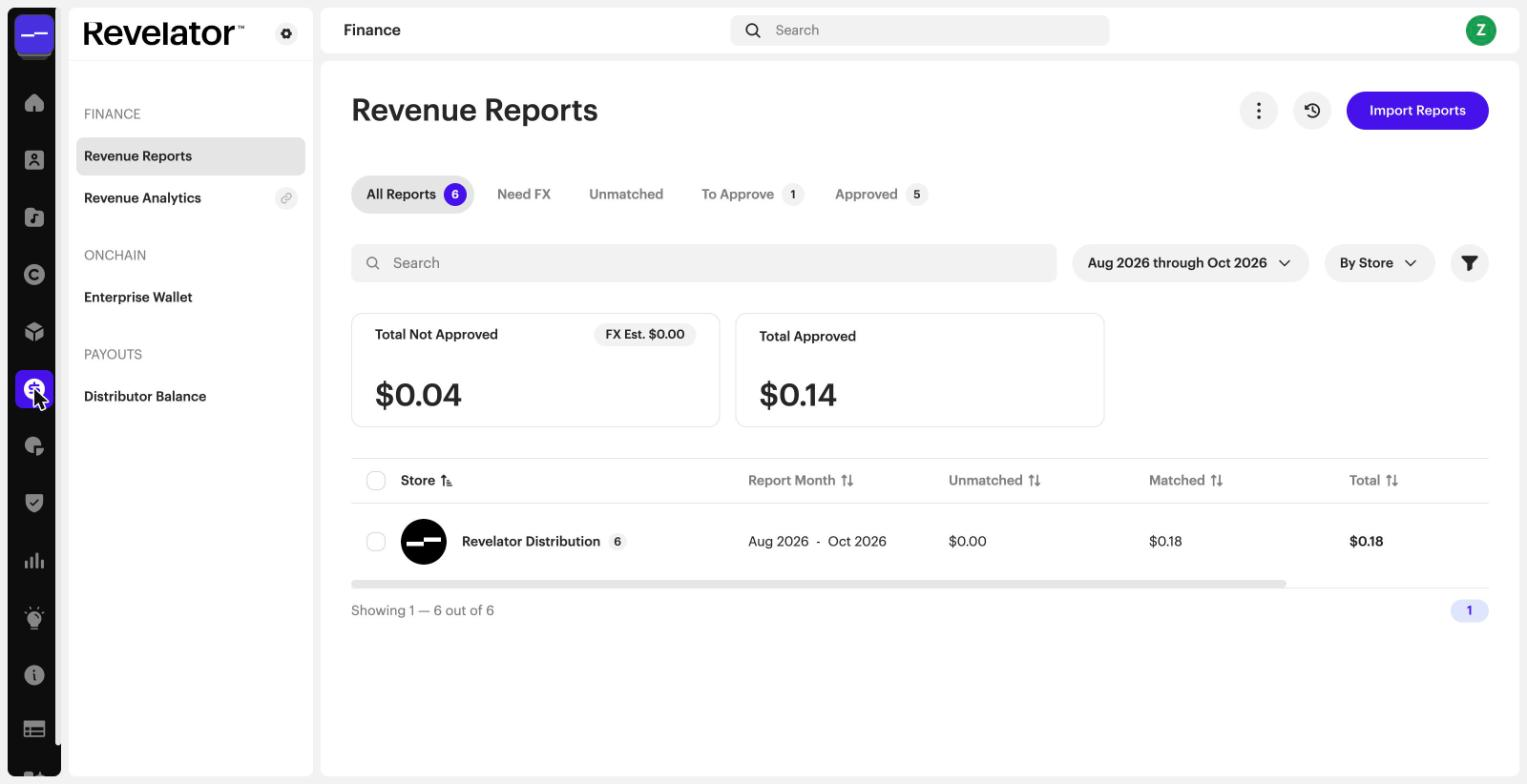
- Go to Finance → Revenue Reports.
- Reconcile your latest revenue reports against the money received.
- Before you approve your revenue reports, add any adjustments and exchange rates needed. A report in a different currency from your account needs an FX rate before you can approve it and include it in a run.
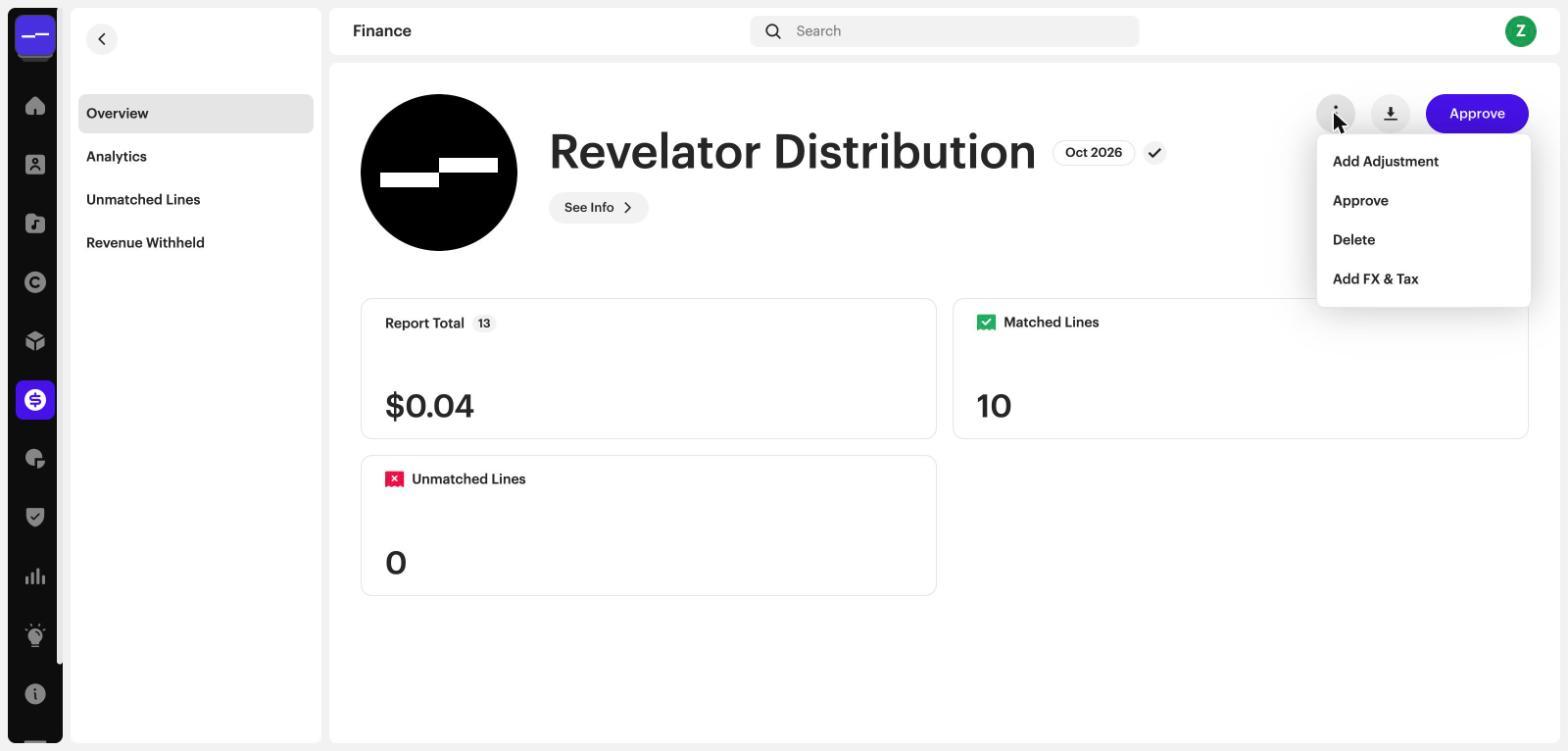
- Approve the revenue reports: open the To Approve tab, click the store name (for example, Revelator Distribution) to show its reports, click a report to open it, then click Approve in the upper-right corner. You can also select Approve from the report's ⋮ menu. Reports that still need an FX rate or have unmatched lines can't be approved until you fix them.
- Make sure all your contracts are created and active. You can create more contracts from Rights → Contracts.
- Fix any unallocated revenue from earlier royalty runs (see Fixing Unallocated Revenue). Unallocated revenue carries forward to later runs until you fix it.
| Important Only the contract's Status (Active or Inactive) decides whether a royalty run uses it; the start and end dates don't. |
Step 2: Create a royalty run
Before you begin
|
Start a new royalty run
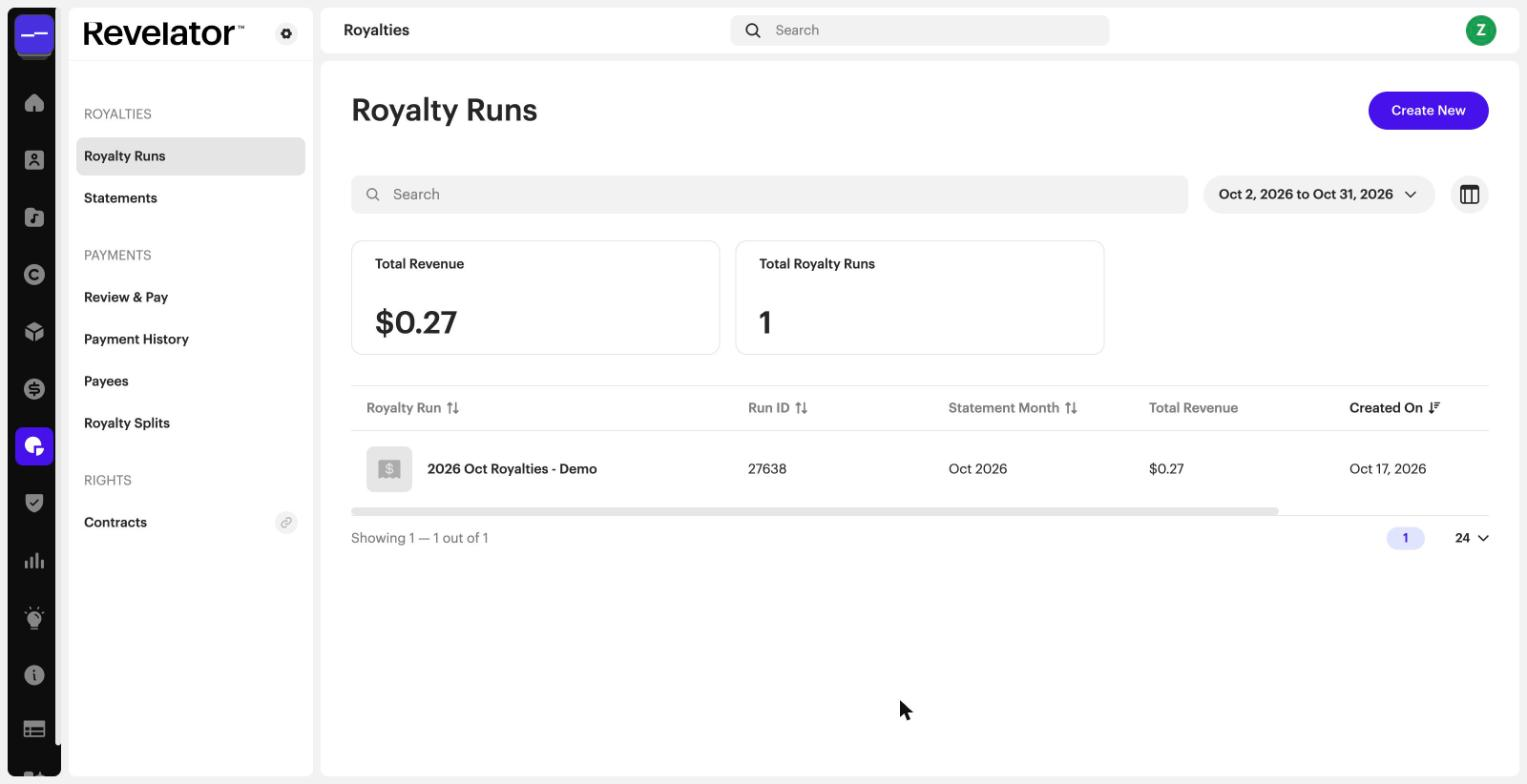
- Go to Royalties → Royalty Runs.
- Click Create New
Name the royalty run
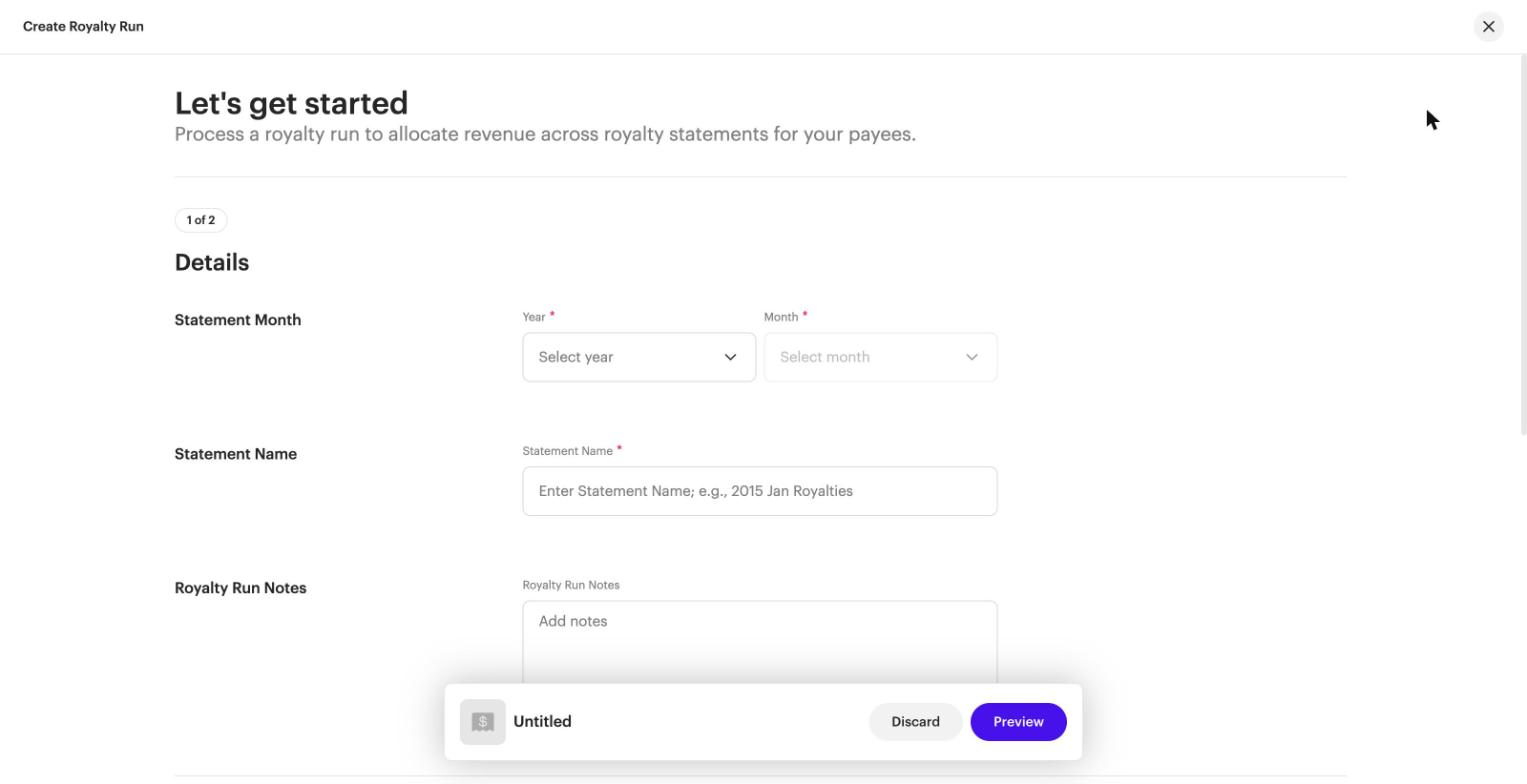
- Enter the year and month for the run. Choosing a month makes all approved reports up to and including that month available for the run.
- Name the statement, for example “Your Company Name Monthly Statement.” This is the title your payees see on their statements.
- Optional: add Royalty Run Notes. Only you see these notes.
| Tip The Statement Name isn't dated automatically, so include the year and month in it. |
Select the unprocessed reports
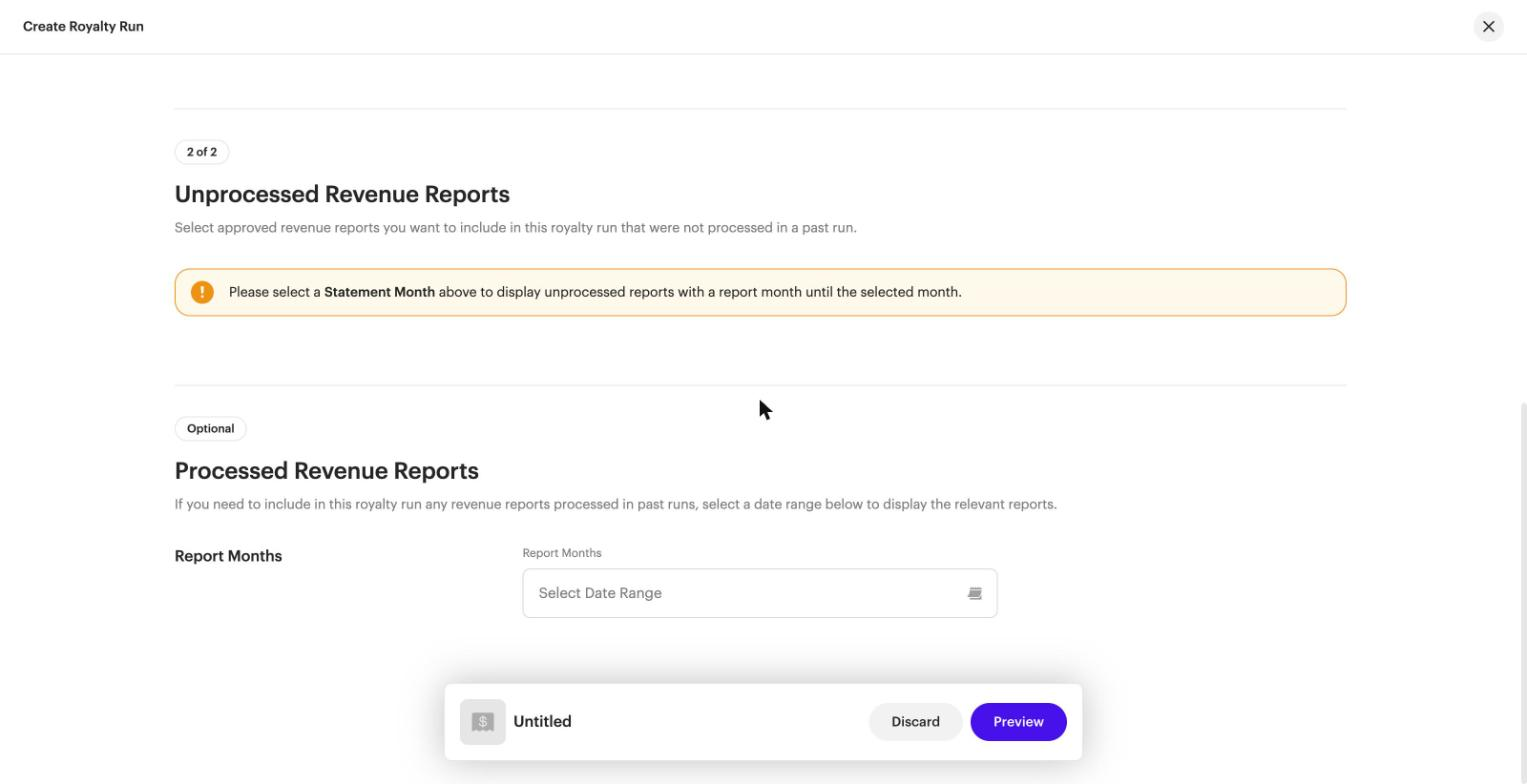
- Select the revenue reports you want to include when generating the statements. They're listed under Unprocessed Revenue Reports. Only reports in the Approved tab can be included; the To Approve, Unmatched, and Need FX tabs show reports that still need work.
- Optional: to include a report that was already processed in an earlier run, select it in the Processed Revenue Reports section.
Preview and create the run
- Click Preview.
- The preview shows the approved reports included in the run and the approved reports not included. Check that every revenue report that should be in the run has been selected.
- If the preview is correct, click Create Run.
Wait for your statements
The run shows the status Pending while your statements are generated. This usually takes up to about an hour, but can range from a few minutes to a day, depending on the size of the run and the queue.
You'll get an email notification once the statements have been generated.
| Important You must then approve the statements so your payees can see them in their portals. |
Step 3: Check the completed run
When the run is complete, open it and check it before you approve the statements:
- Check Included Reports and Detached Reports to confirm the right reports were used.
- If you see an Error tag, click it to see the details.
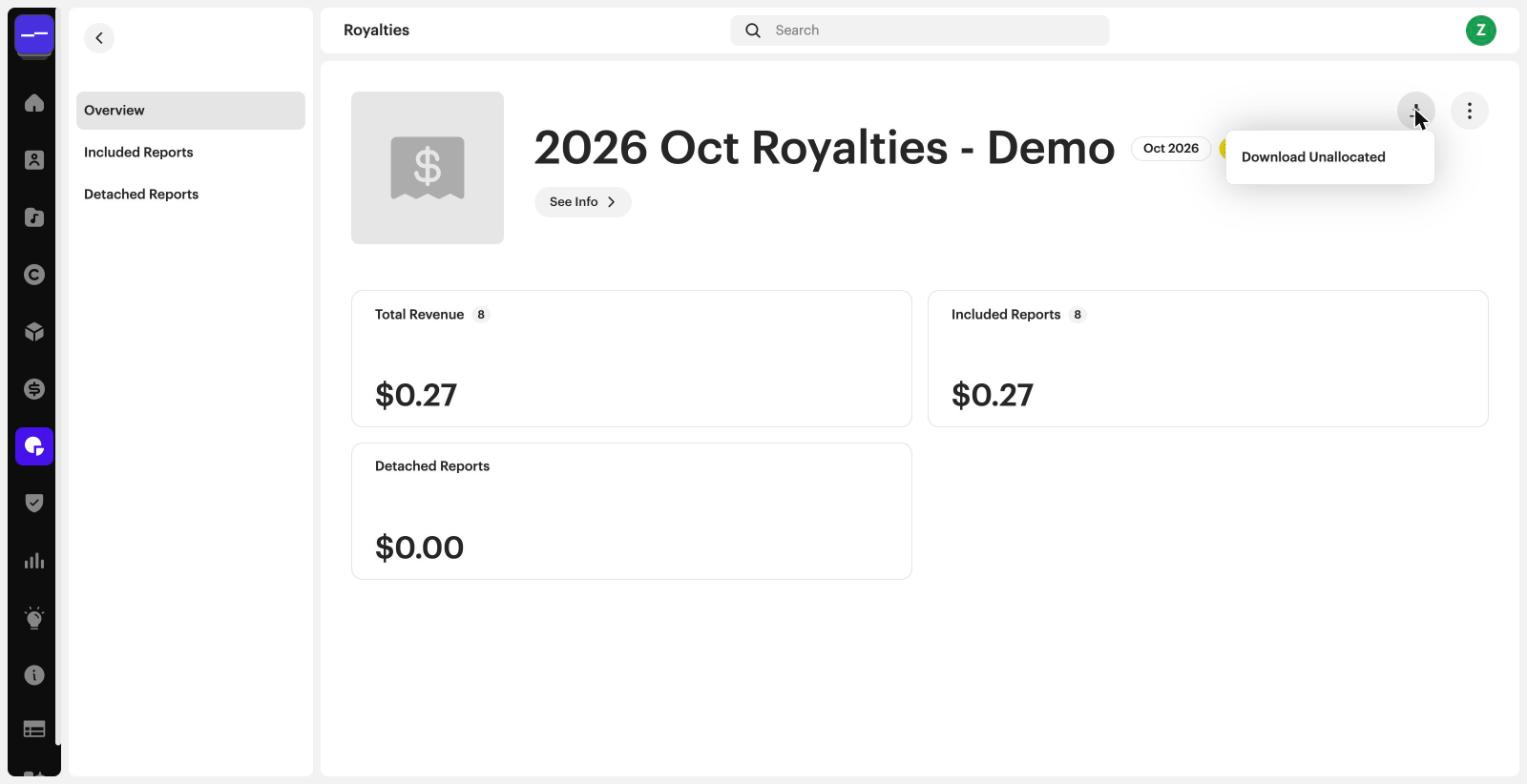
- A yellow X icon next to the run name means the run has unallocated revenue. Click the download icon and select Download Unallocated. See Fixing Unallocated Revenue.
- To download a payee's statement, go to Royalties → Statements, open the statement's ⋮ menu, and select Download CSV or Download HTML Summary.
Step 4: Approve statements
| Important The generated royalty statements aren't visible to your payees in their portals until you approve them. |
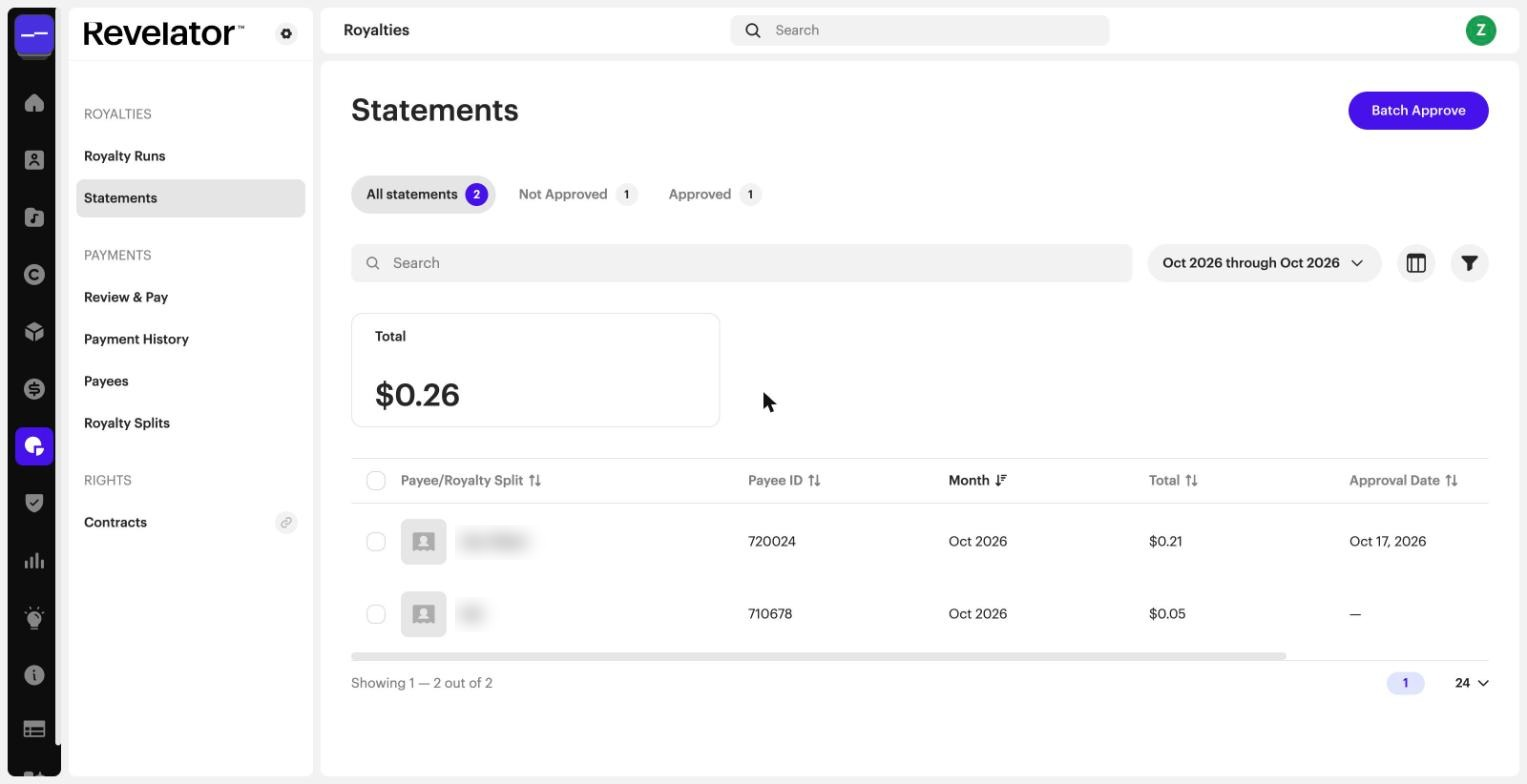
- In a batch: go to Royalties → Statements and click Batch Approve.
- One at a time: go to Royalties → Statements, open the statement's ⋮ menu, and select Approve.
- To email statements: once a statement is approved, its ⋮ menu shows Email. To email every statement in a run, go to Royalties → Royalty Runs, click the run, open the ⋮ menu, and select Email all Statements.
For the full steps, including what approving does and how to download statements, see Approving and Sending Royalty Statements.
Correct a run
Contracts are applied at the moment the run is created. If a statement is wrong because of a contract:
- If you haven't paid the statements yet: fix the contracts, then Reset the run. Resetting deletes the run's statements, resets the payee balances, and generates new statements using your corrected contracts.
- If you've already paid: add an Adjustment transaction on the payee for the difference (negative or positive). Revelator doesn't create a correcting charge for you.
Troubleshooting
A revenue report doesn't appear in section 2 of the run
If a revenue report doesn't appear in section 2 of the run (selecting the reports), check whether:
- The report hasn't been approved yet. Only approved reports can go into a run.
- The report's month is after the Statement Month you chose.
- The report was already processed in an earlier run. Look for it in the Processed Revenue Reports section.
- The report is in the To Approve, Unmatched, or Need FX tab of section 2. Fix it and approve it first.
Frequently asked questions
How do I fix errors after a royalty run is finalized?
Unapprove the affected statements (open the statement's ⋮ menu and select Unapprove), make your corrections, then approve them again. You can't unapprove a statement that has already been paid: add an Adjustment transaction instead (see Correct a run), or contact support.
What decides whether a royalty run uses a contract?
Only the contract's Status (Active or Inactive). The start and end dates don't.
When can a payee see their statement?
Only after you approve it.
Related articles
Was this article helpful?
That’s Great!
Thank you for your feedback
Sorry! We couldn't be helpful
Thank you for your feedback
Feedback sent
We appreciate your effort and will try to fix the article